The Finnish Fiasco, Chapter Eight
A muddy path led from the barn to the back entrance of the Pink Castle, where the kitchen was located. The door was unlocked, and Celia entered to find herself in a large room with tall ceilings and a flagstone floor. An enormous black stove stood against one wall, and in the center of the room was a round wooden table. In the refrigerator she found bread, eggs, butter and milk. Celia turned the stove on and began preparing breakfast. Oliver was right, French toast was easy to make and even kind of fun. She had finished cooking the first batch and was sprinkling powdered sugar on top when she heard screaming.
“I hate my face, I hate it! I’m tired of looking like a potato! Daddy, I need a plastic surgeon!” A teenage girl stomped into the kitchen and stopped short when she saw Celia.
“Who are you, and what are you doing here?” the girl asked. This was not the way one expects to be greeted, unless one has been warned that the inhabitants of one’s new home are horrible people.
“I’m your cousin, Celia, and I’m cooking breakfast because that’s what your father told me to do.” She dipped another slice of bread into the egg, then dropped it into the skillet.
“Whatever it is you’re making smells atrocious,” she said. “Make me something else.”
She did look rather like a potato, with small, close-set eyes and a lumpy face.
“Have you heard of the word ‘please?’” Celia asked. “If you want something, it’s a good idea to use the word ‘please’.”
“I don’t say ‘please’ to servants,” the girl replied.
“I’m making French toast,” Celia said. “If you don’t care for any then you can make your own breakfast. And I’m not your servant.” Celia had already helped herself to three slices of French toast while she was cooking, complete with an extra thick dusting of powdered sugar. It was much better than the herring.
“You’ll make what I tell you to make,” the girl said. “If you don’t, I’m telling Daddy and you’ll get fired.”
“That’s fine with me,” Celia said. What did she care if she got fired? Maybe she’d be sent back to North Carolina.
The girl’s face turned purplish, making her look even more like a potato, and she put her hands on her hips. She opened her mouth to say something, but was interrupted by two boys who walked into the kitchen on their hands, their bare toes pointing toward the ceiling. “Don’t pay attention to old Potato-Face,” one of the upside-down boys said, “she complains about everything.”
“Even though complaining never does any good,” said the other boy.
Celia couldn’t tell what the boys looked like because it’s difficult to make sense of an upside-down face unless you are upside-down, too. She put down her spatula and bent over so that her head was upside-down also. The very moment she was getting a proper perspective, the boys sprang upright. They looked identical with floppy red hair and gray eyes. Their attire was rather strange, unless red striped tights and yellow suspenders were what boys normally wore in Finland.
“Are you twins?” Celia asked, guessing that they were about her age.
“No,” they replied, in unison.
“You are so,” Celia was very quick on the uptake and it was not easy to pull the wool over her eyes.
“If you already knew, then why did you ask?” said Boy Number One.
“It’s so boring to have every person we meet ask uif we’re twins. So predictable. Can’t people think of anything interesting to ask? Like what’s our favorite color? Or, if our house were on fire and we could only save one thing, what would it be? Or, have we ever been abducted by aliens? But no. It’s always ‘Are you twins?’ And the second question people ask is also always the same,” said Boy Number Two.
Celia thought about what question she would have asked next. It probably would have been to ask if they’d like some French toast. But someone else, someone who had not been coerced into being a family servant, someone who had not been forced to live in a drafty and decrepit barn infested with Stinking Stable Scarabs, someone who had not been given an expired can of herring for dinner, would probably ask which boy was older, because people like to place other people into categories and age is one way to do that.
“Is the second question ‘Which one of you is the oldest?'” she asked.
“You’re a genius!” said Boy Number One. Or maybe it was Boy Number Two.
“May I have some of whatever it is you’re cooking?” asked either Boy Number One or Boy Number Two.
“You’re not seriously going to eat that stuff, are you?” said the girl. “She might have poisoned it, for all we know. She looks like someone who wouldn’t mind poisoning people.”
“Does she?” asked Boy Number One or Boy Number Two. “How can you tell?” He flipped back up onto his hands, then arched over onto his feet in one smooth movement.
“Can you teach me how to do that?” Celia asked.
“Of course, it’s easy,” Boy Number Two or Boy Number One said. “All you have to do is…” He stopped talking as Paavo entered the room.
“Good morning, offspring. I see you’ve met your little orphan cousin. The bad news is that she’s going to be living with us for a while. The good news is that you won’t have to clean your rooms or scrub your toilets anymore because she’ll be doing it.”
The potato-faced girl rolled her eyes. “Daddy, we’ve never cleaned our rooms or scrubbed our toilets.”
“Really? In that case, you still won’t have to.” Paavo sniffed. “What’s for breakfast?”
“Something disgusting,” said the potato-faced girl. “Tell her to make something non-disgusting, Daddy. Plus, she’s being rude to me.”
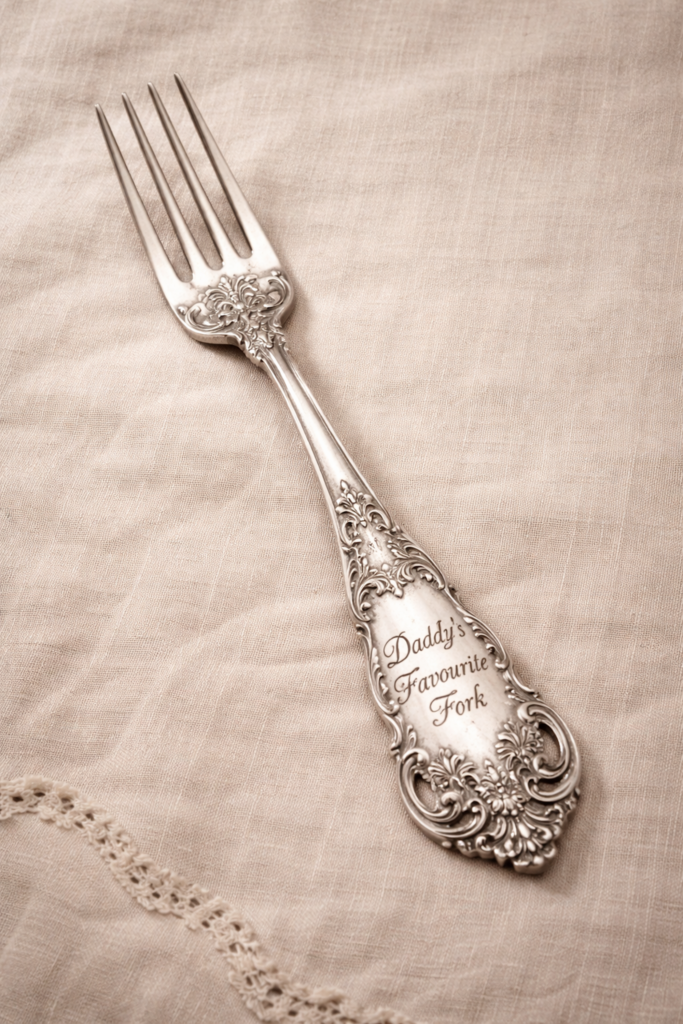
“It smells good to me,” Paavo said. He walked over to the stove and peered into the skillet. “Mmm, French toast! Bring me four slices with maple syrup and my favourite fork.” He settled himself at the table.
“Could you introduce me?” Celia said. “I don’t know anyone’s name—except for yours, Paavo.” She transferred four slices of French toast onto a plate, careful not to let them slide off the spatula. “And I don’t know where the forks are or which one is your favourite.”
“Daddy’s favourite fork says “Daddy’s Favourite Fork” on the handle, so even someone as dim-witted as yourself should be able to figure it out,” said the girl. “And the cutlery drawer is the one with the cutlery–including Daddy’s favourite fork– in it.”
“I’ve been cooking, not reading forks,’ Celia said. “Since you know where it is, why don’t YOU get it?”
“Children! I will NOT tolerate squabbling. Celia, it is your job, not Essi’s, to take care of the household tasks. That includes bringing me my favourite fork.”
Celia had had enough. “I’m not your slave. And I know that you’re getting a lot of money for having me here. So I don’t know why you’re acting like you’re doing me a favor when I’m the one making you breakfast!”
Everyone stopped talking. The twins stared at their father; the potato-faced girl stared at Celia in amazement. “What?” Celia said. “It’s true.”
Paavo opened his mouth but no sound came out. He closed it then opened it again. “Listen up, girly,” he squeaked. “You will behave respectfully, or you will live to regret it.”
“I’m not trying to be disrespectful,” Celia said, and she suddenly wished she had not said anything. “It’s just that I am doing my best to make breakfast and nobody is being nice.”
“Nobody needs to be nice to you,” Paavo said. “You don’t count as a real member of the family. You will do exactly as you’re told by me and my children. This one is Essie, who is my favourite child.” Paavo patted the potato-faced girl on the head. “Jaami and Lukas are good-for-nothing pretzel boys who waste their time practicing for future careers as circus clowns. But they’re still the boss of you.” Essie smirked. Jaami and Lukas gave her sympathetic looks.
Celia decided that her best option was to stop talking. She finished cooking and found the fork which did indeed have “Daddy’s Favorite Fork” engraved on the handle. She placed everything in front of Paavo. He did not say thank you. “Where’s the Baroness?” he asked, as he stuffed food into his mouth.
“She has a headache,” Essie said. “She’s staying in bed today and doesn’t wish to be disturbed.”
“Wonderful!” Paavo said. “I mean, how sad that she isn’t feeling well, but how wonderful that she’s resting. Celia, tell Oliver to take you with him when he drives the children to school. Afterwards, he can take you to the grocery for dinner ingredients.” He belched loudly. “I must say, for a girl who can’t cook, that was tasty. What’s for dinner?”
“What would you like?” Celia asked.
“I want duck confit, like we had in Paris,” Essie said. “But I suppose you’ll say you don’t know how to make it.”
“I want hot dogs,” said Jaami.
“Hamburgers,” said Lukas.
“Okay,” Celia said. In spite of the fact that nobody had thanked her and that Paavo had threatened her and that Essie had been insufferably rude, she had enjoyed making the French toast. Maybe she was destined to be a great chef.
A horn tooted outside. Oliver was waiting, looking dapper in his uniform and cap. He had velcro wrapped around his stumps to grip the steering wheel that was also wrapped in velcro. It was a rather ingenious system, Celia thought. Essie and the boys piled into the back seat, leaving Celia to sit up front.
“Good morning, children,” Oliver said.
“Hi, Oliver,” the boys said. Essie remained silent and stared out the window. The car drove down the twisty lane from the hilltop, past pastures full of ponies, a pond and a woods, to the main road.
“Do you like your school?” Celia asked. She wondered if it was legal for Paavo to make her do housework instead of allowing her to further her education.
“I hate school,” Essie said.
“You hate everything,” Lukas and Jaami said in unison.
“I hate you two,” Essie said. “Why don’t you run away now and join the circus? Nobody would miss either of you.”
The car arrived at the school, and Essie and the twins got out. Essie stalked off without a word, but the boys thanked Oliver and said goodbye to Celia.
“I’ll teach you how to walk on your hands tonight,” Jaami said.
Celia watched them run off towards the school and thought how lucky they were to have a normal life. If having a sister who hated you and a father who called you good-for-nothing could be called normal. She still hadn’t met the Baroness, as the mother of the family was called, or Arsi, the uncle, but they couldn’t possibly be worse than Paavo, could they?
Back in the kitchen, later that afternoon, Celia assembled the ingredients that she and Oliver had bought at the market. She had found a recipe for duck confit in a cookbook titled “French Favourites”, that was on a shelf next to the stove. Since the duck needed to soak in salt water for twenty-four hours, she had decided to make the hotdogs and hamburgers tonight, and the confit tomorrow.
“What are you doing?” Paavo had come into the kitchen silently, and Celia jumped when he spoke. It’s creepy to think you are alone and then discover someone standing right next to you, breathing over your shoulder. You wonder how long they have been standing there, breathing and watching.
“I’m making dinner,” Celia said.
“That doesn’t look like duck confit to me,” Paavo said. “Did I or did I not hear Essie order duck confit?”
“The duck needs to soak in salt water for a day. We’ll have the confit tomorrow.” Celia was feeling rather proud of her cooking progress. Just yesterday she couldn’t cook at all. Now she was going to make a complicated French dish.
“I’m not interested in your excuses. If you are told to prepare duck confit, then I expect to see duck confit!”
Celia thought quickly. Paavo was not reasonable, and when one is dealing with unreasonable people one must be prepared to think quickly. There is no sense in trying to reason with them anymore than there is any sense in trying to reason with an eggplant. You will get nowhere with either an eggplant or an unreasonable person.
“Of course,” Celia said. “The thing is, I want Essie to have the best confit possible. I’m sure she would like it to be as good as the meal she remembers from Paris. But if you would like me to skip the essential step of brining and make it today, I will begin right away.”
Paavo frowned. “Well, I wouldn’t want my princess to be disappointed. I guess you can make it tomorrow. But what will we eat tonight? I’m already hungry.”
“I’m making hot dogs and hamburgers— that’s what the boys asked for.”
“I hope it’s going to be good. If nobody likes it, I’m assigning you extra floors to scrub.”
“I’m sure everyone will enjoy the meal,” Celia said, with more confidence than she felt.