Golden Hours Rest Home
I just wanted to eat my chicken salad in peace and read my kindle. Undisturbed. I hate being interrupted when I’m eating, and I hate being interrupted when I’m reading. And I really, really hate being interrupted when I’m eating and reading. But the Golden Hours Rest Home was short-staffed, as usual, and Ginny, the director, had asked me to sit in Miss Viola’s room during my lunch break, instead of outside on the bench under the tulip magnolia, where I usually took my break.
“I’m begging you, Dara—I just don’t have the staff to cover breaks today. Keisha’s out post- appendectomy for god knows how much longer, not that I can blame her for that, of course, Stanley’s on vacation for five more days, and Tamara—well, you know all about that.” Ginny was actually wringing her hands as she delivered this speech. I always thought hand-wringing was something metaphorical, but she was literally wringing her large, red, chapped hands in desperation.
I sighed. The book I was reading was fiction, loosely based on the real life of a woman who had been a spy in occupied Paris during WW2. It was riveting, and I’d just reached a chapter where the woman was going to have to ‘compromise her morality’, as the book phrased it, with a Nazi officer, or else possibly cause the deaths of innocent civilians. I knew, of course, that she was going to choose ‘compromise’ as the lesser of the two evils, but I couldn’t wait to read about how it actually happened. “Okay,” I said, “but only if I stay on the clock—if I can’t leave the building, then I should get paid for my non-break lunch.” There actually wasn’t enough money in the world to compensate for giving up my lovely bench and thirty minutes of tranquility, but Ginny was a good boss, and had always treated me fairly. So I didn’t feel right refusing her. I knew she would have to go sit in Miss Viola’s room if I said no.
Ginny heaved a sigh of relief. “Thank you, Dara! I can always count on you.”
Miss Viola was one of the sweeter residents at Golden Hours. She’d been here for a little less than a year, ever since she’d taken a fall at her home and broken a hip. I tell you, whenever someone breaks a hip, it’s the beginning of the end. I refuse to live in a house with stairs for just that reason, even though I’m only thirty-two and not exactly high-risk for a broken hip, but I’m not taking any chances. I’ve seen this story too many times. A person living at home, perfectly fine, independent, and then BOOM. They fall, break a hip, and it’s a downward spiral to the graveyard from there. Nope. No stairs for me. I live in a little one story bungalow in my town of Asheville, North Carolina. No stairs anywhere, unless you count the three steps from the kitchen door into the garden. I had hand rails installed and I use them every single time.
Although Miss Viola was a sweet-natured little old lady, she had begun to lose her sense of reality since being admitted to Golden Hours. It happens a lot and I can understand why. There you are one minute, living your life in the home you’ve been in for decades, probably where you raised your family, had pets, cooked dinners and sat in your garden with a glass of wine in the evenings, and then the next minute you’re being bundled off into a strange place where you have people poking and prodding you, no privacy, everything smells of urine and the dingy corridors are full of old people shuffling aimlessly behind walkers or being pushed along in wheelchairs with nurses speaking to them like they’re children. I’d want to check out mentally, too. The reality of the situation is unbearable. So Miss Viola had become confused and was prone to climbing over her bedrails and trying to escape. Probably trying to find her way back to her old home, which sadly, her daughter told me, no longer exists because it was bulldozed to make a parking garage. Is that not the most depressing thing ever? So poor Miss Viola cannot be left alone.
Normally, we have an unskilled aide to cover breaks for patients like Miss Viola, but like I said, we are short-staffed due to a perfect shit-storm of events which I won’t go into, but I will give you the example of Tamara, just so you have some idea of what this place is like. Ginny is great, yes, but she alone cannot fix the myriad problems that exist at Golden Hours.
Tamara (pronounced ‘Tuh-mahr-uh’—accent on the second syllable) is a nice girl. She really is. Or was. She doesn’t work here anymore, as you may have gathered. Tamara was a registered nurse. We have one on duty for every shift; it’s mandatory, because licensed practical nurses like myself, and of course the aides, are not allowed to administer medications. State law requires that all medications be dispensed by the registered nurse. And Tamara was having some ‘personal difficulties’ as they say. They were pretty major difficulties. She was a single mother with an autistic teenager by one absent father, and a hyperactive three year old by another, also absent father. And she’d just found out she was pregnant by her unemployed meth-addict boyfriend. Yeah, she made some bad choices, but who knows at the time that you’re making bad choices? It could happen to anyone, but people shake their heads like they are so much better and smarter and they would never end up like Tamara. Me, I know it could happen to me. Although, after hearing Tamara’s tale of woe, I went directly to Planned Parenthood and had a Mirena IUD inserted. There is no fucking way I am going to find myself saddled with a couple of mental kids and no dad in the picture. Actually, I’m hesitant even to date anymore, and it’s been eight months since I’ve had sex, so the Mirena is probably redundant, but better safe than sorry.
It gets even worse with the Tamara situation. So her meth-head live-in boyfriend somehow got access to her bank account —how that happened, I have no idea. I wanted to ask, but poor Tamara had so much crap raining down on her it seemed in poor taste, so I didn’t. This boyfriend cleans out her bank account and spends it all on drugs. Tamara found out when her rent check bounced. So she got kicked out of her apartment, with the two kids, and had to move in with her divorced alcoholic mother who lives in a trailer way out in the boonies of Leicester County. The mother spends her days drinking Jack Daniels and blasting Def Leppard. Can you even imagine? The autistic teenager sits in a corner banging his head against the fake fireplace and the hyperactive three year old is bouncing off the flimsy walls, and the whole time Tamara is at work she’s afraid her mom is not watching the three year old and he might be drowning in the creek that runs behind her mother’s single wide. Meanwhile, she doesn’t know what to do about this pregnancy. She wants to have an abortion, but she’s Baptist and afraid she’ll burn in hell if she does.
I said to her, “Tamara, hell could not be any worse than your life right now. For god’s sake, get an abortion immediately, today if possible, while it’s still early.” But Tamara can’t make up her mind. Meanwhile, she’s super stressed about money, and has the worst possible idea ever about how to get some quick cash. Basically, she fakes the documentation on some patient charts and says that she gave them Percocet or Demerol for pain, and she pockets the drugs and sells them through her meth-head ex-boyfriend who for some reason is also still her actual boyfriend (I’ll admit, that right there does indicate a certain mental deficiency on the part of Tamara). She told me the whole story when we went out after work to Rocky’s Hot Chicken Shack for some wings and a couple beers—mainly to give Tamara the strength to deal with her drunk mother and Def Leppard for the rest of the evening. I didn’t know what to say. I wished she hadn’t told me. I couldn’t snitch on her—she was my friend—but I felt weird having this knowledge, because I knew—I just knew—that she was going to get caught. And she did. And she got fired, and I don’t even know where she is now, or what she’s doing. She hit me up for a couple hundred and I gave it to her—I knew she’d never pay it back, but I couldn’t say no. Besides, she needed it more than me.
So that’s just a little backstory on this place, Golden Hours. Have you ever noticed how the names of rest homes or nursing homes or whatever you want to call them are so ridiculously inappropriate? I mean they should be called something truthful, like ‘Shithole’ or ‘If You’re Lucky, You’ll Die Before You Ever Get Here,’ something along those lines. But no, they call them ‘Peaceful Acres’, or ‘Magnolia Plantation’ or in this particular case, ‘Golden Hours Rest Home’. Ha. Golden, my ass.
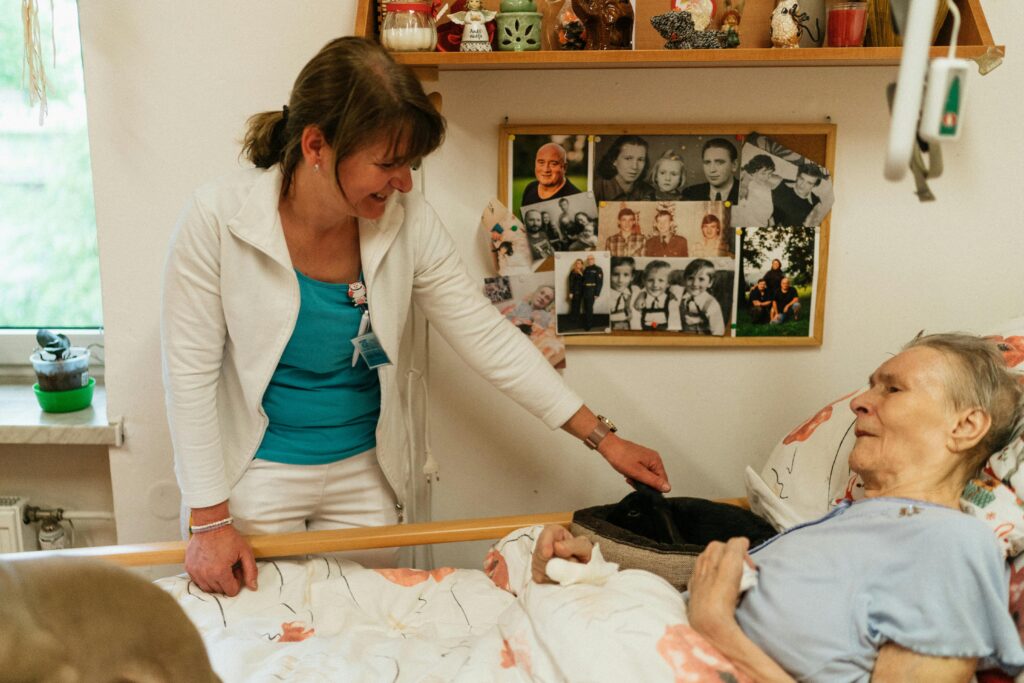
I crack open the door to Miss Viola’s room. She had a Haldol about an hour ago, so I’m hoping she’s asleep and I can read in peace. I tiptoe into the room, and gently close the door behind me. I’m in luck. Miss Viola is flat on her back, her papery old face almost as white as her pillowcase, her mouth open. Her chest is barely rising and falling with each shallow breath that she takes. She’s wearing an old flowered blouse that is not buttoned all the way up (I need to speak to the aide about that—how hard is it to do up some buttons, for chrissake?) I can see the outline of her ribs. She’s so awfully thin because she hardly eats anything. She has a case of ensure on her bedside table, but I know from experience that she doesn’t like Ensure. Says it tastes like vomit. That’s her description, not mine.
I sit down in the ugly vinyl guest chair and start reading. I left my chicken salad in the employee refrigerator because I cannot eat in a patient room. They don’t smell too great for one thing and for another it just seems unsanitary. Bedpans and adult diapers and whatnot all over the place. No thanks. The heroine of my novel, Elodie, is a young, blonde twenty-three-year-old who drinks red wine and chain-smokes and is drop-dead gorgeous. She had a boyfriend, but he got shipped off to fight somewhere and she has no idea if he’s even still alive. Her father is dead and her mother is a cripple living in a basement in the 6th arrondissement, and Elodie is the only way her mother has to get food. So there’s a lot of pressure on the girl even before she gets a job as a translator for the Nazis and catches the eye of a high-ranking officer. I’m just getting into the part where the officer lets Elodie know that he finds her attractive—in a manner that sounds quite gentlemanly, but you know that underneath that politeness is a threat, and that if she doesn’t sleep with him there will be ugly consequences— when I hear the bed squeak.
“What are you reading, Dara? That is Dara, isn’t it? All you young girls look so similar, and I don’t know where my glasses are.”
This is typical for Miss Viola. Some days she’s completely batty, and other days she is as sharp as you or me. I sigh. At least I’m on the clock, so I guess I shouldn’t feel resentful about being interrupted. “Hi, Miss Viola, yes, it’s me, Dara. How are you?”
“Oh, I guess I’m fine. How are you? Do you know if my daughter is coming today?”
“Today is Wednesday, and your daughter comes on Tuesdays and Thursdays,” I say. “Sometimes on Saturdays with your great-grandsons.”
“It’s so hard to keep track of the days, Dara. Do you have trouble too, or is it just me?” Sometimes these old people will break your heart. I try not to let myself get emotionally attached; I keep a distance, maintain a hard shell. Because who needs more sad, emotional drama in their life, I ask you? Nobody, that’s who.
“Sometimes I have trouble, too, Miss Viola,” I say. I actually don’t, unless I had too many beers the night before, but I don’t need to tell her that.
“What are you reading,” she asks again, peering at the kindle in my lap.
“Oh, it’s about this woman who was a spy in Paris, during WW2.” I look at the kindle in my lap. Maybe I could read aloud to Miss Viola? Entertain both of us? Kill two birds with one stone, so to speak?
Miss Viola seems to perk up. She finds the button to raise the head of her bed and her eyes are actually sparkling when she looks at me.
“I was a spy in occupied Paris, did you know that?” She sounds perfectly coherent, but I can only assume the Haldol is kicking in and instead of making her sleepy, it’s sending her off into an alternate reality.
“Umm, no, I didn’t know that,” I say. Just for kicks, I do the math. I know how old she is, and if she had been a spy in occupied Paris (haha), that would make her—-I have to stop and concentrate because math has never been my strong point—it would make her ninety-six, give or take, which, I realize, is exactly what age her chart says she is. Just a coincidence, though.
“Yes,” Miss Viola continues, warming up to her topic. “My name was Violetta then. Violetta Bertrand. After I married Russell—he was an American GI—I changed my name to Viola. Easier for Americans to say. I became Viola Smith—Mrs. Russell Smith. But inside, I have always thought of myself as Violetta.” Miss Viola is fingering the edges of her ratty old quilt, as if it somehow helps her recall her earlier life. I, myself, am wondering now if this could be a true story? How could she suddenly make this up on the spur of the moment? Miss Viola has never been one to make up stories, at least not that I’m aware of.
“We were hiding a Jewish mother and her baby in our apartment,” she continues. “My parents had hired her to work for them at the cheese shop they owned. I don’t know if she was married or if she was, what had happened to her husband.” She stares out the window at the Canada geese who are eating grass and shitting all over the golf course next door. But Miss Viola doesn’t look like she’s actually seeing the geese. “I didn’t want to know anything about her. I was glad we were helping her, on the one hand, because otherwise she surely would have been sent to one of those camps. Both she and her baby. But on the other hand—I was afraid my family was going to be killed if anyone found out about her.”
“Did anyone find out?” I guess that nobody did, or Miss Viola wouldn’t be here today.
“No, nobody did, thank the Lord.” She smiled. “And then I was told I had to work for the Nazis, translating documents. I was fluent in French, German, and English because my mother was raised on the French/German border and was bilingual, so I grew up bilingual, and I studied English in school.”
Miss Viola’s eyes cloud over. “What day is it today? Isn’t my daughter supposed to be here?” She falls back against her pillow. “I’m so tired.”
I am dying to hear the rest of the story. I want to know what she did, exactly, as a spy, and if she was forced into any romantic encounters with the Nazis. I want to know what happened to the Jewish woman and her baby. I want to know where she met her husband and if she ever returned to Paris or if she planted her roots here in America and never looked back. But that will have to wait until lunchtime tomorrow, because Miss Viola is fast asleep.