Chewing Chilcuague

I first discovered this intriguing plant at a mezcal tasting. An acquaintance, who is an expert on mezcal (a liquor made from agave plants), brought several different mezcals to a local restaurant. He described the characteristics of the mezcals, and passed around a bowl of chilcuague, which looked like brown twigs. He instructed us to take a sip of mezcal and notice the flavor. Then we were to gently chew a piece of chilcuague for a minute or two, followed by another sip of mezcal (after removing the chilcuague) and compare the before and after tastes.
I took a sip of the mezcal, then popped a two inch long twig into my mouth and chewed. Nothing happened for about fifteen seconds, and then suddenly I felt an intense tingling and my mouth filled with saliva. I wouldn’t describe it as burning, exactly, but it had a strong peppery/spicy taste. Almost at the same time the tingling sensation began, I noticed that my tongue and the inside of my cheeks felt numb. I kept the chilcuague in my mouth for about a minute, and although I wouldn’t say it was an unpleasant experience, neither would I describe it as pleasant (I think a smaller piece would have been better!) I expected the flavor of the mezcal to be diminished afterward, because my tongue felt numb, but strangely enough, the taste was intensified. It was a curious experience, and I still don’t understand how my sense of taste could increase when my tongue, and presumably my taste buds, had decreased sensation.
I asked where I could buy my own stash of chilcuague to experiment with (and also to give as a unique gift to friends and family back in the states) and was told to go to a nearby town and look for the old abuelas (grandmothers) who sit on the sidewalk near the taxi stand. I went, and indeed, I found my chilcuague. The abuelas sell all sorts of seeds and herbs as well as the chilcuague.
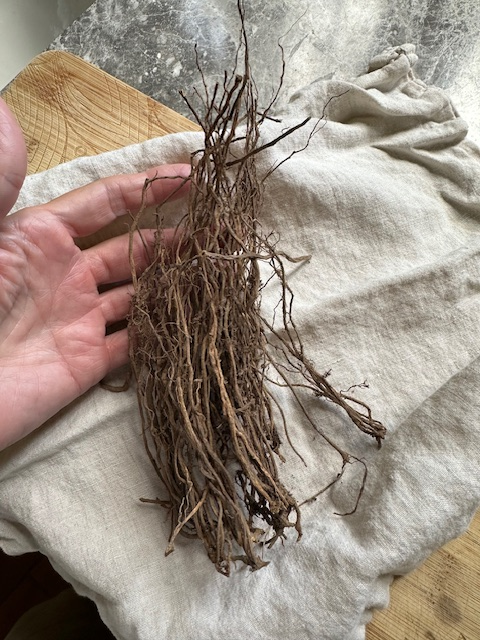
In addition to culinary uses, chilcuague has been used as a medicine since precolonial times. Alfinin is the name of the alkamide which gives this root its antifungal, antibacterial, and analgesic properties. Traditionally, it has been used for conditions ranging from sore muscles and joints to toothaches, insect bites and athletes foot.
The word ‘chilcuague’ comes from the Nahuatl word ‘chilmetacl’, which can be loosely translated as ‘spicy rope’. When you buy chilcuague, what you are actually buying are the dried roots of the daisy-like plant, Heliopsis longipes (aka Philactis longipes), a yellow-flowering perennial in the aster family. It is known as ‘golden root’ or ‘raic de oro’, in Spanish. It grows mainly in north central Mexico, specifically in the states of Guanajuato, San Luis Potosi, and Queretaro. This root is used as a condiment in cooking, and is also used in alcoholic beverages. I have never seen it on a restaurant table, and I haven’t come across any recipes calling for it, but I’m going to be on the lookout!
I often wonder about traditional medicines like chilcuague. How were the medicinal properties orginally discovered? Was someone walking by these yellow flowers one day and they thought: “Hmm–I think I’ll dig up this plant and chew on the roots.” Or were certain people in the community assigned the job of sampling plants in the surrounding environments to discover which ones were edible, which ones were toxic and which ones could be used for treating various ailments? Perhaps they observed animals digging up the roots? It’s quite the mystery, and I guess we’ll never know the answers with any certainty.


