The Voluptuous Visnaga
What Are Visnaga Cacti?
I first discovered these beauties while visiting a friend’s house. Susan is one of those people who never have dirty dishes in the sink, the beds are always made, and there is nary a weed to be found in her garden. Of course, she also has a full time housekeeper and gardener. I tell myself that I would be just as tidy if I had household help. But that’s a lie. I am a naturally lazy and disorganized person, and besides, I’m not really bothered by cobwebs. But I digress. Those viznagas!

In Mexico, any round cactus is referred to as a visnaga, or bisnaga. I’m not sure if the Spanish language has some sort of rule governing use of the letter b vs the letter v, but as far as I can tell, they are used interchangeably (I’ve always loved that Mark Twain quote—“ I never thought much of a man who could only spell a word one way”). The term generally refers to barrel shaped cacti in the genus Echinocactus and Ferocactus. They tend to be more rounded when young, and become more cylindrically shaped as they age. They usually have prominent ribs and formidable spines. The ones my friend had were echinocactus grusonii, and they looked like prickly little balls of sunshine. My friend (or her gardener, rather) had arranged them in groups of three and five across a planting bed that was anchored at each end by agaves. I fell in love on the spot and decided I needed to purchase a truckload of these babies. But when I asked where she bought them, she didn’t know. The gardener did all the purchasing of plants.
Thus began my search. I snapped a photo of them so I could show the viveros and ask if they had any of these visnaga, and if not, could they order some. I found a place outside of Leon, (a city in Guanajuato state, about 40 minutes from the city of Guanajuato, where I lived at the time) a large vivero with lots of Golden Barrels in stock. But I was not prepared for the price! A largish one —approximately twelve inch diameter—was over $50.00 USD! Needless to say, I was not going to be getting a truckload. I ended up buying three of them that day (I couldn’t squeeze more than that into the back of my little Honda—they were planted in large wooden boxes) But since then, whenever I see any of the smaller ones for sale (fifteen dollar range) I’ll grab a couple, and maybe in a few years time I’ll have a garden that looks as dramatic as Susan’s. There’s always room to pop in just one more. They’re so cheery!
When you go to the viveros in Mexico, the plants are not labeled. In the USA, I’ve never seen plants NOT labeled in the retail nurseries, usually with those little flat plastic tabs that are stuck into the pots. I have yet to see that in Mexico. If you ask the staff the name of a plant, they will just shrug, or tell you the name of the family, but you’ll never get the genus, species or —heaven forbid— the name of the variety. For example, I saw a Japanese maple tree that I thought I might like. But there are a zillion different types of Japanese maples and I wanted to know how tall this one would grow, what color it turned in the fall, etc. The only thing the owner of the vivero could tell me was that it was a ‘maple’. Seriously, that was it! I do have a plant identifying app on my phone, but when I’ve tested it (by using plants I already know) it’s hit or miss as far as getting an accurate name. However, the Golden Barrel is so unique, that it’s instantly identifiable. So when I asked at my favourite vivero if they could order some for me (and showed a photo), the owner agreed. When I returned a week later to pick them up, he told me that they had arrived, but another customer had immediately bought them! I didn’t ask why he sold the plants he had ordered specifically for me, but I guess he wasn’t sure I would actually return to buy them, and a bird in the hand….Anyway, he ordered more, and eventually I did get them. He now keeps them permanently stocked because I am not the only person in love with these cacti.
A Few Types of Visnaga Cacti
1. Golden Barrel Cactus (Echinocactus grusonii)
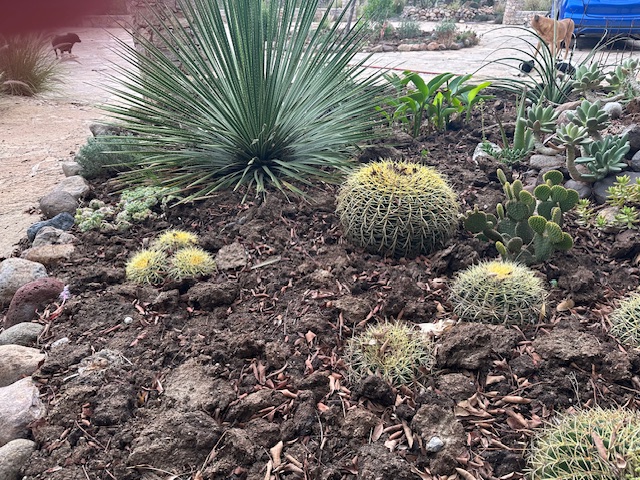
As mentioned above, this is my favourite and perhaps the most famous visnaga. It’s immediately recognizable by its perfectly rounded shape and sunny spines. Native to central Mexico, this species can grow up to three feet in diameter and height. They are slow growers, but I’ve discovered that with water (I water them about once or twice a week) and full sunshine they grow much more quickly. In the wild, they are classed as critically endangered, but it’s one of the most commonly cultivated ornamental cacti worldwide.
2. Devil’s Head Cactus (Echinocactus horizonthalonius)
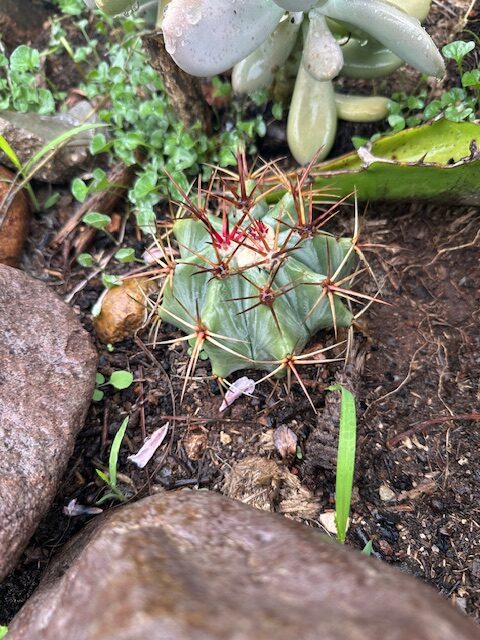
This smaller barrel cactus is a bluish-green to grayish color and has impressive purplish-red spines. Native to the Chihuahuan Desert and parts of the southwestern United States and northern Mexico, it typically grows to about eight to twelve inches in height. It has a distinctive blue-green color and gorgeous purple flowers. I think I might have one of these (photo above). Often people will have plants on the sidewalk to sell, and if something catches my eye I’ll buy it even if I have no idea what it is. That’s where I bought this little guy, and it hasn’t grown at all (that I can see) in the four years I’ve had it, and has never flowered. I might move it to a different location, although they are known to be slow growing and it appears happy enough.
3. Fishhook Barrel Cactus (Ferocactus wislizeni aka Ferocactus tiburonensis)
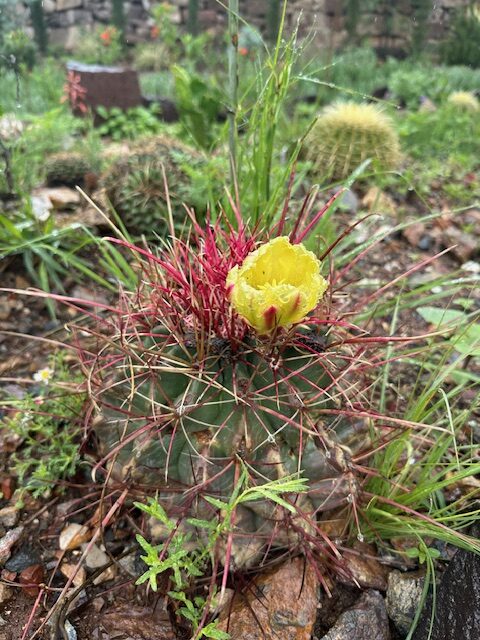
This impressive barrel cactus is marked by its tall, cylindrical shape and hooked spines. It can reach heights of up to 6 feet in its native habitat of the Sonoran Desert. The curved, fishhook-like central spines give this cactus its common name and they were historically used by indigenous peoples for fishing. I’m not 100% sure that’s what this cactus is–I bought it from a stand alongside the highway. It’s hard to id visnaga conclusively, because there are so many subspecies and hybrids. Cactiguide.com has photos and descriptions of the thirty known species.
4. California Barrel Cactus (Ferocactus cylindraceus)
Native to the southwestern United States and northwestern Mexico, this species features dense yellow spines that often take on a reddish hue at the tips. It typically grows in a more columnar fashion than other barrel cacti, sometimes reaching heights of up to 10 feet in optimal conditions. I don’t have one of these yet, so no photo at the moment.
5. Fire Barrel Cactus (Ferocactus gracilis aka Ferocactus viscainensis, Ferocactus gatesii)
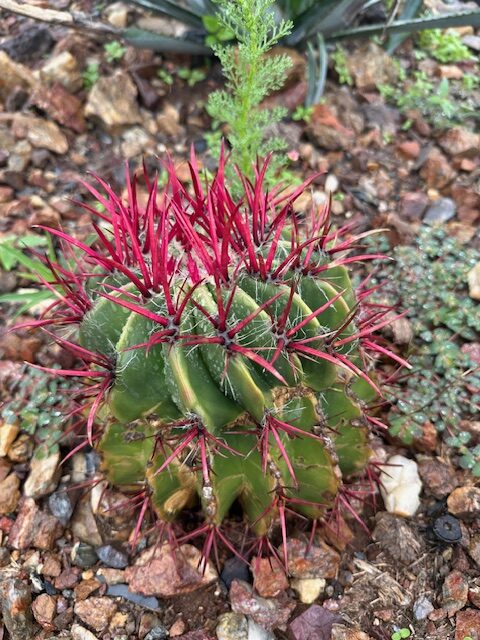
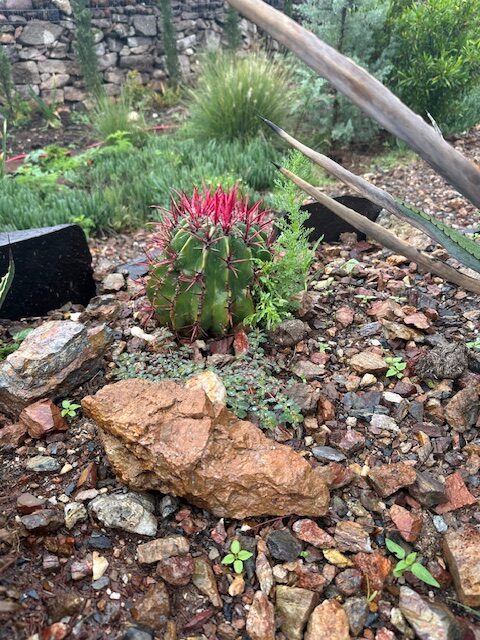

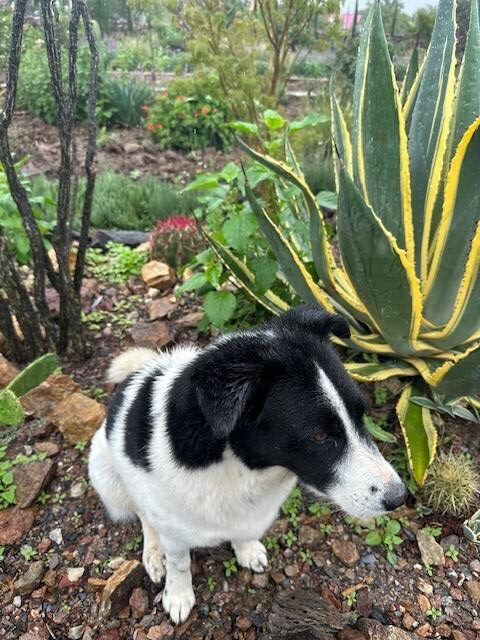
This striking species has bright red spines that give it a fiery appearance, especially when backlit by the sun. Native to Baja California, Mexico, it’s a popular ornamental choice for its vibrant coloration and moderate size (typically 2-3 feet tall). I bought several of these from the same roadside stand where I bought the fish hook cactus, above. These photos were taken today, in the rain. We’ve had over a week now of cool, overcast days with intermittent showers, and the garden is happy! (George is not happy, because we haven’t gone for a walk today)
Natural Habitats
Visnaga cacti are primarily native to the desert regions of the southwestern United States and Mexico. They’ve have evolved to thrive in some of the harshest environments on Earth, such as:
Sonoran Desert
The Sonoran Desert includes parts of Arizona, California, and northwestern Mexico and is home to several Ferocactus species. This desert is unique for its bi-seasonal rainfall pattern, receiving precipitation in both winter and summer. The additional moisture allows for greater biodiversity, and barrel cacti here often grow alongside other iconic species like the saguaro.
Chihuahuan Desert
The Chihuahuan Desert stretches from the southwestern United States far into central Mexico and you’ll find several species of visnaga there, including Echinocactus horizonthalonius. Most of the limited rainfall here occurs during summer months.
Central Mexican Highlands
The Golden Barrel Cactus (Echinocactus grusonii) is native to the semi-arid central highlands of Mexico (where I live!), particularly in the states of Hidalgo and Querétaro. Unfortunately, much of its natural habitat has been destroyed by the construction of the Zimapán Dam, one of the factors contributing to its critically endangered status in the wild. I’ve never seen one growing wild, although I’m always on the lookout.
Ecological Adaptations
Visnaga cacti have evolved in ways that allow them to survive in extreme desert conditions:
- Water storage: Their barrel shape maximizes water storage capacity while minimizing surface area exposed to the sun.
- Accordion-like pleats: The distinctive ribbing allows them to expand when absorbing water and contract during drought periods. (I’d love to see a time lapse sequence of this)
- Spination: Their impressive spines shade the cactus body, reducing water loss while also deterring herbivores. I don’t know how they do it, but my neighbor’s cows will demolish the nopal cactus that grow along the roadside by my house. The nopals have some serious spines, but the cows chow down on them like nobody’s business. The spines on the golden barrel cactus have a Fibonacci-like pattern.
- Shallow root systems: Most visnaga cacti have extensive but shallow root systems that can quickly absorb rainfall before it evaporates.
- CAM photosynthesis: CAM stands for ‘Crassulacean Acid Metabolism’. Many plants–including cacti– in arid environments use this specialized form of photosynthesis that allows them to open their stomata at night (when temperatures are cooler) to minimize water loss.
Caring for Visnaga Cacti
Light Requirements
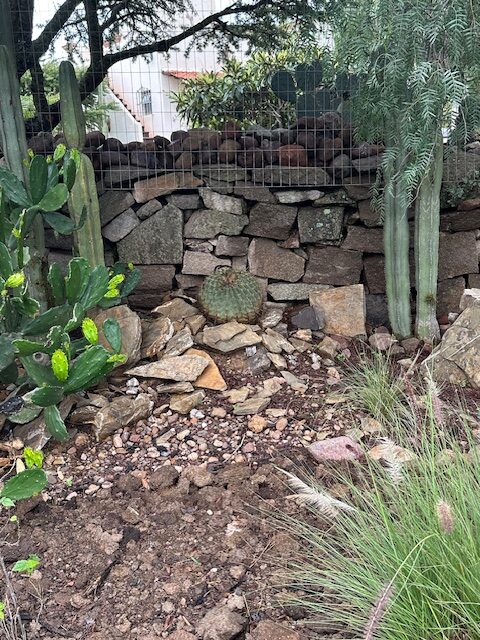
Obviously, visnaga cacti are sun-lovers that require bright, direct light to thrive. When grown indoors, they should be placed in the sunniest window available, ideally south-facing (in the Northern Hemisphere). Outside, they prefer full sun exposure but may benefit from light afternoon shade in extremely hot climates. I have some echinocactus platyacanthus that are growing in pretty much full shade (see photo above), and they seem fine, although they do not grow as quickly as those in full sun. My Golden Barrels, on the other hand, start to fade and look unhappy if they aren’t in full sun for most of the day.
Watering Needs
The cardinal rule for visnaga cacti care is: when in doubt, don’t water. They are far more tolerant of underwatering than overwatering. During the growing season (spring and summer), water deeply but infrequently—typically every two to four weeks, allowing the soil to dry completely between waterings. In winter, reduce watering to once every one to two months or even less when temperatures are cool. I don’t follow these rules. I give all my visnaga (as well as other cacti) a squirt of water whenever I’m watering everything else, and they seem to appreciate it. But I am at 7,400 feet of elevation and it is extremely hot and dry here. There’s pretty much zero chance of them getting too much water.
Soil Requirements
Well-draining soil is absolutely essential. A commercial cactus mix will work, or you can create your own by combining regular potting soil with sand, pumice, or perlite in roughly equal proportions. You can also toss in a handful of gravel at the bottom of your planting hole to help with drainage. Again, I don’t follow these recommendations. I just dig a hole and plop them in. So far, so good.
Temperature Tolerance
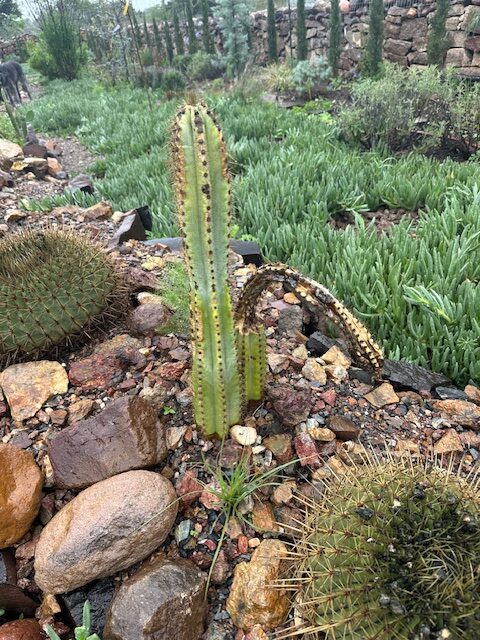
Most visnaga cacti can easily tolerate high heat but have varying cold tolerance. Species like the Golden Barrel can be damaged by temperatures below freezing, while some Ferocactus species can briefly withstand temperatures down to about 20°F (-6°C). When growing these cacti in cooler climates, container cultivation is probably safest, so they can be moved to protected areas during winter. Here in central Mexico, during the months of January and February, we will occasionally have temps that dip below freezing during the night (I know because the hose will be full of ice in the morning). But it’s very brief, and during the day, the temps are usually in the 60s F. I’ve never lost a visnaga or even seen one that had any damage due to these brief freezes, although some of my other cacti have been badly damaged. Photo above of frost damaged blue torch cactus (pilocereus pachycladus azureus) I’m hoping it recovers, but it doesn’t look good. The visnaga next to it were not damaged at all.
Fertilization
Visnaga cacti are not heavy feeders. During the growing season, you can apply a diluted cactus fertilizer once or twice. Always use fertilizer at half the recommended strength, and never fertilize during dormant winter periods or when the cactus is stressed. I use cow and horse manure as compost, so I have never done any extra fertilization of the visnagas.
Common Issues and Troubleshooting
Etiolation
If your barrel cactus begins to look elongated or stretched out, it’s not receiving enough light. This condition, called etiolation, can’t be reversed once it occurs. Prevention through adequate light exposure is key.
Root Rot
The most common killer of visnaga cacti is overwatering leading to root rot. Signs include discoloration (often yellowing or darkening) at the base, softening of tissues, and a general unhealthy appearance. If caught early, the cactus may be salvaged by unpotting, removing rotted roots, treating with fungicide, and repotting in fresh, dry soil. If your visnaga is planted directly in the garden, you should follow the same steps and replant in a drier section of your garden.
Pest Problems
While generally resistant to pests, visnaga cacti can occasionally suffer from mealybugs, scale insects, or spider mites. Treatment with isopropyl alcohol applied with a cotton swab takes care of small infestations, while insecticidal soap or neem oil can address larger problems. I used to use neem oil as a foliar spray for insect problems, and then I learned that it’s toxic to honeybees—so —be aware.
Conservation Status
Several visnaga species are threatened in the wild. My favorite, the Golden Barrel, is listed as critically endangered on the IUCN Red List due to habitat loss (the dam earlier mentioned) and over-collection (ie poaching). Buying from reputable nurseries that propagate their stock (rather than selling wild-collected specimens) is always the best option. (Yes, I know, I probably should not have bought from the roadside stands…)
Conclusion
So, if you live in a suitable climate and want to add some easy pizzazz to your garden, you really can’t go wrong with visnagas. I think they look best planted in groups of three or five (like my friend did), and in the front of the garden where they can best be seen. You might also take into consideration the way the sunlight falls on them, because when they are backlit by morning or afternoon sun they are truly breathtaking.